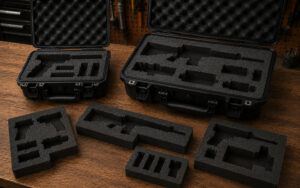
Creating compartments inside protective hard cases helps keep equipment secure, organised, and protected during transport or storage.
The most common ways to create compartments are with custom foam inserts, padded dividers, or modular interior systems. Each option offers different levels of flexibility, protection, and precision depending on the type of equipment being stored.
Protective case compartments are widely used for cameras, drones, electronics, tools, firearms, medical equipment, scientific instruments, and specialist equipment.
Why are compartments important in protective cases?
Compartments help stop equipment from moving inside the case during transport.
Without proper internal organisation, equipment may:
- Slide around inside the case
- Knock against other items
- Become scratched or damaged
- Be harder to organise and access
A well-designed compartment system improves both protection and usability by giving each item its own secure space.
What are the main ways to create compartments in a case?
The three most common compartment systems are:
- Custom foam inserts
- Padded divider systems
- Modular tray or divider layouts
The best option depends on the type of equipment, how often the layout changes, and the level of protection required.
How do custom foam inserts work?
Custom foam inserts use shaped cut-outs that match the size and shape of the equipment being stored.
The foam holds each item securely in place to reduce movement and absorb impact during transport.
Custom foam inserts are commonly used for:
- Cameras and lenses
- Drones and controllers
- Medical equipment
- Firearms and accessories
- Scientific instruments
- Industrial tools
They provide one of the highest levels of protection because the equipment fits closely inside the foam.
What types of foam are used for compartments?
Different foam materials are used depending on the equipment and the required level of protection.
- Polyethylene foam: A firm and durable foam with strong impact resistance.
- Polyurethane foam: A softer foam suitable for delicate surfaces.
- EVA foam: A dense foam often used for clean, precise custom layouts.
The right foam depends on the weight, shape, and fragility of the equipment being protected.
How do you cut custom foam compartments?
Creating custom foam compartments starts with measuring the equipment accurately and planning the layout inside the case.
The process usually involves:
- Measuring the equipment dimensions
- Creating templates or outlines
- Marking the foam carefully
- Cutting the foam gradually
- Testing the fit regularly
Tools commonly used include:
- Electric carving knives
- Utility knives
- Hot wire foam cutters
- Foam cutting saws
Professional foam inserts are often created using CNC cutting machines for greater accuracy and cleaner finishes.
What is pick-and-pluck foam?
Pick-and-pluck foam is a pre-scored foam insert made from small removable cubes.
Users can remove sections by hand to create simple compartments without specialist tools.
Pick-and-pluck foam is useful for:
- Basic layouts
- Temporary storage solutions
- Changing equipment setups
- Simple DIY customisation
However, it usually provides a less precise fit than custom-cut solid foam.
What are padded divider systems?
Padded divider systems use adjustable fabric-covered dividers to create compartments inside the case.
These systems are commonly used in:
- Camera cases
- Drone bags and cases
- Audio equipment cases
- General equipment storage
Divider systems are useful because they can be adjusted or reconfigured quickly without cutting new foam.
They are often a good choice for users who regularly change equipment layouts.
What are modular compartment systems?
Modular systems use removable trays, inserts, or adjustable dividers to create flexible storage layouts.
These systems can include:
- Stackable trays
- Removable sections
- Adjustable divider panels
- Combination foam and divider layouts
Modular interiors are popular for professional equipment where storage requirements may change between projects or jobs.
How do you plan a compartment layout?
A good layout should protect the equipment while making efficient use of the available space.
When planning compartments, consider:
- The size and shape of each item
- Weight distribution inside the case
- Space between compartments
- Ease of access
- Protection for delicate parts
- Storage for accessories and cables
Heavy items should usually sit near the base of the case, while fragile equipment should have additional padding around sensitive areas.
How tight should equipment fit inside compartments?
Equipment should fit securely without excessive pressure.
A properly fitted compartment should:
- Prevent movement during transport
- Support the equipment evenly
- Allow easy removal
- Avoid pressure on delicate components
- Keep accessories separated
If the fit is too loose, the equipment may move around. If it is too tight, pressure may damage lenses, screens, controls, or mounted accessories.
Which compartment system is best?
The best system depends on how the case will be used.
Custom foam inserts are often best for:
- Maximum protection
- Delicate or expensive equipment
- Professional presentation
- Long-term fixed layouts
Padded dividers and modular systems are often better for:
- Flexible equipment setups
- Frequent layout changes
- Mixed equipment storage
- General-purpose transport
Many professional users combine several compartment methods to balance flexibility, organisation, and protection.