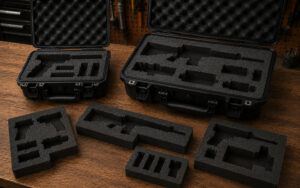
Cutting case foam requires the right tools to create clean, accurate shapes that hold equipment securely inside a protective hard case.
The best tools depend on the type of foam being used, the complexity of the layout, and the level of finish required. Some tools are better for rough cuts, while others are designed for more precise detail work.
Custom foam inserts are commonly used for cameras, drones, tools, electronics, firearms, medical equipment, and specialist instruments where secure positioning and impact protection are important.
What basic tools are needed to cut case foam?
Most foam cutting projects can be completed using a few essential tools.
Commonly used tools include:
- Electric carving knives
- Sharp utility knives
- Hot wire foam cutters
- Foam cutting saws
- Measuring tools and rulers
- Markers or chalk for layout lines
- Templates for accurate shapes
The right combination depends on the foam material and the level of accuracy needed.
Why are electric carving knives popular for foam cutting?
Electric carving knives are commonly used because they cut through foam quickly and create smoother cuts than many standard hand tools.
They work particularly well for:
- Removing large foam sections
- Cutting straight lines
- Creating basic equipment compartments
- Working with medium-density foam
Electric knives are often a good option for general case foam customisation at home.
What does a hot wire foam cutter do?
Hot wire foam cutters use heat to melt through foam rather than slicing it with a blade.
This can help create:
- Smoother edges
- Cleaner finishes
- More detailed shapes
- Reduced foam tearing
Hot wire cutters are often used for precision work and custom layouts where a more professional finish is required.
They are particularly useful for EVA foam and detailed cut-outs around equipment shapes.
Can you cut case foam with a utility knife?
Yes. A sharp utility knife can be used for simple foam cutting tasks, trimming edges, and making smaller adjustments.
Utility knives work best when:
- The foam is relatively thin
- The cuts are simple and straight
- Minor adjustments are needed
- The foam is soft or medium density
Sharp blades are important because dull blades can tear the foam and create rough edges.
Blades may need replacing regularly during larger projects.
What tools are best for different foam types?
Different foam materials respond differently to cutting tools.
Polyethylene foam
This high-density foam is firm and durable, making it suitable for protective hard cases.
Best tools include:
- Electric carving knives
- Foam cutting saws
- Sharp utility knives
Polyurethane foam
This softer foam is easier to cut and is often used for delicate equipment protection.
Best tools include:
- Utility knives
- Electric knives
- Scissors for thin sections
EVA foam
EVA foam is denser and commonly used for precision-cut inserts.
Best tools include:
- Hot wire cutters
- Sharp craft knives
- CNC cutting machines
How do you measure foam before cutting?
Accurate measuring is one of the most important parts of creating a custom foam insert.
Before cutting:
- Measure the equipment carefully
- Include handles, cables, scopes, or accessories
- Allow slight clearance around each item
- Plan the layout inside the case
- Mark the cutting lines clearly
Many people create templates using cardboard or paper before cutting directly into the foam.
This helps reduce mistakes and improves accuracy.
How do you create clean and accurate foam cuts?
Creating neat cuts usually involves working slowly and checking the fit regularly during the process.
Good cutting practice includes:
- Using sharp blades
- Cutting gradually rather than forcing the tool
- Removing foam in layers where needed
- Testing the equipment fit regularly
- Keeping cutting lines straight and consistent
Complex layouts may require several smaller cuts instead of one large cut.
What safety equipment should you use when cutting foam?
Foam cutting should always be carried out in a safe and well-ventilated area.
Recommended safety equipment includes:
- Protective eyewear
- Dust masks
- Heat-resistant gloves for hot tools
- A stable cutting surface
Hot wire tools can produce fumes, so good ventilation is important when using heated cutting equipment.
When should you use professional foam cutting services?
Professional foam cutting services are often useful for complex layouts, expensive equipment, or projects requiring a highly accurate finish.
Professional cutting is commonly used for:
- Photography and video equipment
- Medical devices
- Drone equipment
- Scientific instruments
- Industrial tools
- Presentation and display cases
Many professional services use CNC cutting machines to create precise, repeatable shapes with clean edges and consistent depth.
Why do the right foam cutting tools matter?
The quality of the foam insert directly affects how well the equipment is protected inside the case.
Using the correct tools helps:
- Create a more secure fit
- Reduce equipment movement
- Improve shock protection
- Extend the life of the foam
- Give the case a cleaner and more professional finish
Whether creating a simple DIY insert or a complex custom layout, the right tools make it easier to achieve accurate results and reliable equipment protection.