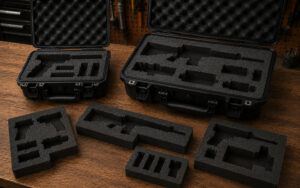
Foam padding inside hard cases protects equipment by absorbing impacts, reducing vibration, and preventing movement during transport and storage.
The foam compresses when force is applied, helping spread impact energy across a wider area rather than allowing that force to transfer directly into the equipment.
Different foam materials and densities provide different levels of protection depending on the type of equipment being stored.
What does foam padding actually do inside a hard case?
Foam padding acts as a protective buffer between the equipment and the hard outer shell of the case.
Its main functions include:
- Absorbing impacts
- Reducing vibration
- Preventing movement
- Protecting delicate surfaces
- Distributing pressure evenly
Without foam padding, impacts and vibration would transfer directly into the equipment, increasing the risk of damage.
How does foam absorb impacts?
Foam contains thousands of tiny air-filled cells.
When the case experiences an impact, these cells compress and absorb energy.
This helps reduce the force reaching the equipment inside the case.
As the foam compresses, the impact energy is spread over a larger area and over a slightly longer period of time, reducing shock loads on sensitive components.
Why is foam compression important?
Foam needs room to compress properly during impacts.
If the equipment fits too tightly against the case walls, the foam cannot absorb energy effectively.
Correct compression helps:
- Reduce impact force
- Protect delicate components
- Prevent pressure points
- Improve long-term equipment protection
Good protective case design always includes enough clearance for controlled foam compression.
How does foam prevent equipment movement?
Foam inserts are shaped to hold equipment securely in place.
This reduces internal movement caused by:
- Vehicle vibration
- Rough handling
- Air travel turbulence
- Dropping or carrying the case
Reducing movement is important because repeated vibration and impacts can gradually damage equipment over time.
What are the main types of foam used in hard cases?
Several foam materials are commonly used in professional protective cases.
Polyethylene foam
Polyethylene foam is a high-density closed-cell foam used for rugged protection.
It offers:
- Excellent impact absorption
- Moisture resistance
- High durability
- Good structural support
It is commonly used for industrial tools, firearms, drones, and heavy equipment.
Polyurethane foam
Polyurethane foam is softer and more flexible.
It provides:
- Gentle surface protection
- Good vibration damping
- Conforming support for delicate equipment
This foam is commonly used for:
- Cameras
- Optics
- Electronics
- Precision instruments
EVA foam
EVA foam provides firm support with excellent dimensional stability.
It is often used for:
- Custom equipment layouts
- Professional presentations
- Complex multi-item configurations
EVA foam also produces clean, precise cuts for custom inserts.
How does foam density affect protection?
Foam density controls how firm or soft the padding feels.
Low-density foam
Low-density foam compresses easily and provides softer cushioning.
It works well for:
- Fragile electronics
- Glass surfaces
- Camera lenses
High-density foam
High-density foam offers firmer support and better protection against heavy impacts.
It is commonly used for:
- Heavy tools
- Industrial equipment
- Firearms
- Large drones
Choosing the correct density helps balance cushioning with structural support.
What is pick-and-pluck foam?
Pick-and-pluck foam contains pre-scored cubes that can be removed by hand to create equipment compartments.
This type of foam allows users to customise layouts without specialised tools.
Benefits include:
- Quick customisation
- Flexible layouts
- Lower cost
However, it does not provide the same precision or long-term durability as professionally cut foam inserts.
What are custom-cut foam inserts?
Custom-cut foam inserts are precisely shaped around specific equipment using CNC machinery or precision cutting tools.
Benefits include:
- Maximum equipment security
- Improved organisation
- Reduced movement
- Professional appearance
- Better long-term protection
Custom inserts are commonly used for high-value or delicate equipment.
Why does foam layout matter?
Correct foam layout helps distribute weight evenly and improves protection during transport.
Good layouts:
- Separate accessories from main equipment
- Keep heavy items balanced
- Prevent items contacting each other
- Allow safe equipment removal
Equipment should never be tightly packed without adequate cushioning between components.
How do foam inserts help reduce vibration?
Foam absorbs low-level vibration created during transport.
This is important because constant vibration can damage:
- Electronic components
- Optical systems
- Calibration settings
- Mechanical assemblies
Foam acts as a dampening layer between the equipment and the rigid case shell.
How long does protective foam last?
The lifespan of foam depends on:
- Foam quality
- Usage frequency
- Environmental conditions
- Weight of stored equipment
High-quality closed-cell foams generally last longer because they resist:
- Compression damage
- Moisture absorption
- Shape deformation
Foam should be replaced if it becomes:
- Compressed permanently
- Torn or damaged
- Loose-fitting
- Contaminated
Can foam protect against moisture as well?
Closed-cell foams such as polyethylene and EVA resist moisture absorption.
This helps maintain protection inside waterproof hard cases by reducing the risk of trapped moisture around equipment.
Open-cell foams absorb water more easily and are less suitable for wet environments.
Why foam padding is essential in protective hard cases
Foam padding is a critical part of any professional protective case system.
It helps absorb impacts, reduce vibration, prevent equipment movement, and improve long-term equipment safety during storage and transport.
Choosing the correct foam type, density, and layout helps ensure equipment remains properly protected in demanding environments.