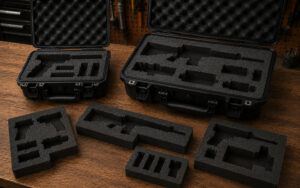
Properly packing a hard case protects valuable equipment from impact damage, vibration, moisture, and movement during transport.
The goal is to create a secure, balanced layout where equipment remains stable without being compressed or placed under pressure.
Professional hard case packing combines:
- Correct weight distribution
- Protective foam configuration
- Equipment separation
- Movement prevention
- Environmental protection
What is the most important rule when packing a hard case?
The most important rule is ensuring that all equipment fits securely while maintaining balanced weight distribution.
Heavy items should sit:
- Low in the case
- Near the centre
- Evenly balanced from side to side
This prevents the case from tipping, shifting, or placing stress on handles and latches during transport.
Equipment should fit snugly enough to prevent movement but never so tightly that foam becomes over-compressed.
Why does weight distribution matter in hard cases?
Poor weight distribution can cause:
- Internal equipment movement
- Case instability
- Foam compression damage
- Stress on hinges and handles
Top-heavy cases are especially vulnerable during transport.
If a case tips suddenly, even high-quality foam may not fully protect sensitive equipment from impact forces.
Professional protective cases such as those from HUSK Cases are engineered for durability using high-impact shell construction, but correct internal organisation remains essential for proper protection.
How should foam inserts be organised inside a hard case?
Foam should be layered strategically to absorb impacts and stabilise equipment.
Base foam layer
The bottom layer should use firm, high-density foam that provides structural support and absorbs larger impacts.
This layer prevents equipment from bottoming out if the case is dropped.
Main equipment layer
The centre layer contains custom-cut cavities for the equipment itself.
Properly cut foam should:
- Hold equipment securely
- Prevent shifting
- Avoid pressure points
- Support the equipment evenly
Top foam layer
The lid foam layer cushions equipment from above and prevents vertical movement when the case is closed.
Softer polyurethane foam is often used for:
- Cameras
- Displays
- Optics
- Sensitive electronics
Should equipment fit tightly inside foam?
Equipment should fit securely but not tightly.
Foam must compress slightly to absorb impacts effectively.
If the fit is too loose:
- Equipment can move
- Vibration damage increases
- Internal collisions may occur
If the fit is too tight:
- Pressure points develop
- Foam loses cushioning ability
- Delicate components may crack or deform
A properly fitted cavity allows easy removal while still preventing movement during transport.
How much space should be left around equipment?
Most sensitive equipment requires:
- 12–25 mm of foam around all sides
Very fragile equipment such as:
- Optics
- Medical devices
- Precision electronics
may require:
- 25–50 mm of padding
Heavier industrial tools may require denser foam with slightly less clearance.
What should never be packed together in the same compartment?
Certain items should always remain separated inside hard cases.
Liquids and electronics
Liquids should never share compartments with sensitive electronics.
Even sealed containers can leak under pressure or temperature changes.
Sharp objects and delicate equipment
Sharp tools or metal accessories can puncture foam or damage equipment during transport.
These items require separate compartments.
Heavy and fragile items
Heavy equipment should never sit directly beside delicate components without foam barriers between them.
Battery storage
Batteries should be isolated properly to prevent:
- Short circuits
- Heat buildup
- Impact damage
How do modular and custom foam systems improve packing?
Custom foam systems provide precise equipment fitment using CNC-cut cavities based on exact measurements or 3D scans.
These systems:
- Eliminate movement
- Improve shock absorption
- Create professional organisation
- Increase transport safety
Modular systems allow layouts to change as equipment needs evolve.
This flexibility is useful for:
- Film crews
- Drone operators
- Audio engineers
- Field technicians
How do you test if a hard case is packed properly?
After packing the case, perform several basic tests.
Shake test
Close and latch the case fully.
Gently shake it in different directions.
You should hear:
- No rattling
- No sliding
- No internal impacts
Movement inspection
Open the case after transport simulation.
Equipment should remain:
- In position
- Evenly supported
- Properly aligned inside foam cavities
Foam compression check
Inspect foam around equipment.
Foam should:
- Compress slightly
- Return to shape
- Show no crushing or permanent deformation
Transport handling test
Carry the case normally.
The case should feel:
- Balanced
- Stable
- Comfortable to handle
There should be no shifting sensation while walking or lifting.
Why does case size matter when packing equipment?
A case that is too large allows excessive movement.
A case that is too small compresses equipment and reduces foam effectiveness.
The ideal hard case provides:
- Adequate foam thickness
- Accessory storage space
- Safe equipment separation
- Balanced portability
Professional protective case manufacturers such as HUSK Cases offer multiple size options and custom foam services to help users achieve proper fitment and maximum protection.
What are the most common hard case packing mistakes?
- Overfilling the case
- Using foam that is too soft
- Leaving empty spaces around equipment
- Stacking heavy items on fragile equipment
- Ignoring weight balance
- Using worn or compressed foam
These mistakes reduce protection levels and increase the risk of equipment damage during transport.
Why proper hard case packing matters
Even the strongest hard case cannot fully protect equipment if the internal layout is poorly organised.
Proper packing ensures:
- Shock absorption
- Vibration control
- Movement prevention
- Environmental protection
- Long-term equipment reliability
Professional packing techniques help maximise the performance of waterproof, dustproof, and impact-resistant hard cases while extending the lifespan of valuable equipment.