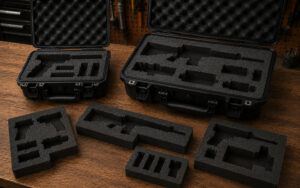
Hard cases are made from durable materials designed to protect valuable equipment from impacts, moisture, dust, and harsh environmental conditions.
The most common hard case materials include:
- High-impact polypropylene
- Aluminium
- Composite materials
- ABS plastic
- Polycarbonate
Each material offers different advantages in terms of:
- Weight
- Strength
- Waterproofing
- Temperature resistance
- Cost
Why material choice matters in hard protective cases
The material used in a hard case directly affects:
- Impact resistance
- Long-term durability
- Waterproof performance
- Transport weight
- Environmental resistance
Professional protective cases must withstand:
- Drops
- Vibration
- Extreme temperatures
- Moisture
- Dust
- Chemical exposure
Different industries require different protection levels, which is why manufacturers use various material combinations depending on the intended application.
What is high-impact polypropylene?
High-impact polypropylene is one of the most widely used materials in modern hard protective cases.
It is a lightweight but highly durable thermoplastic that offers:
- Excellent impact resistance
- Waterproof performance
- Chemical resistance
- UV resistance
- Temperature stability
Professional case manufacturers often use specialised polypropylene blends such as NK-7 resin to improve durability further.
These materials remain stable in temperatures ranging from:
- -40°C to 80°C
This makes them suitable for:
- Outdoor use
- Industrial environments
- Marine conditions
- Air travel
Why polypropylene is popular for professional hard cases
Polypropylene offers an excellent balance between:
- Strength
- Weight
- Cost-effectiveness
Unlike metal cases, polypropylene absorbs impacts by flexing slightly under stress rather than denting permanently.
This flexibility helps protect equipment during drops and rough handling.
It also resists:
- Corrosion
- Saltwater
- Most chemicals
These properties make it especially useful for:
- Camera equipment
- Drones
- Audio gear
- Industrial tools
- Scientific instruments
What are aluminium hard cases?
Aluminium hard cases use rigid metal shell construction to provide strong structural protection.
They are commonly used for:
- High-end presentation cases
- Technical equipment
- Luxury storage
- Electronics transport
Advantages of aluminium cases include:
- Excellent rigidity
- Premium appearance
- Good heat dissipation
- Strong structural support
However, aluminium cases are generally:
- Heavier
- More expensive
- More prone to dents
Unlike polypropylene, aluminium does not flex under impact and may deform permanently after heavy impacts.
What are composite hard cases?
Composite hard cases combine multiple materials to improve specific performance characteristics.
These cases may blend:
- Polymers
- Fibreglass
- Carbon fibre
- Reinforced plastics
Composite materials are often used in:
- Aerospace
- Military equipment
- Medical transport
- High-performance industrial applications
They allow manufacturers to optimise:
- Strength
- Weight
- Rigidity
- Environmental resistance
Carbon fibre composites, for example, offer exceptional stiffness at very low weight, although they are significantly more expensive.
What is ABS plastic in hard cases?
ABS plastic is another common hard case material, particularly in mid-range consumer cases.
ABS offers:
- Good impact resistance
- Affordable manufacturing costs
- Reasonable durability
However, ABS generally provides lower performance than premium polypropylene materials.
It can become more brittle over time, especially when exposed to:
- UV light
- Cold temperatures
- Repeated impacts
ABS cases are commonly used for:
- General storage
- Consumer electronics
- Budget equipment transport
What role do foam materials play inside hard cases?
The interior foam is just as important as the outer shell.
Hard cases commonly use:
- Polyethylene foam
- Polyurethane foam
- EVA foam
Polyethylene foam
This is a high-density closed-cell foam that provides:
- Strong impact absorption
- Moisture resistance
- Long-term durability
It is commonly used for:
- Heavy tools
- Drones
- Industrial equipment
Polyurethane foam
Polyurethane foam is softer and better suited to:
- Optics
- Electronics
- Camera equipment
It cushions delicate surfaces without causing scratches.
EVA foam
EVA foam offers:
- Firm support
- Excellent dimensional stability
- Clean CNC cutting
It is widely used in professional custom foam layouts.
How do hard cases become waterproof and dustproof?
The shell material alone does not create waterproof protection.
Professional hard cases rely on:
- Precision gasket systems
- Pressure equalisation valves
- Reinforced latches
- Tight manufacturing tolerances
Most professional waterproof cases are rated:
- IP67 or equivalent
This means the case is:
- Completely dustproof
- Protected against temporary water immersion
Materials such as polypropylene work especially well for waterproof cases because they resist moisture absorption and maintain dimensional stability.
Why do professional hard cases use pressure equalisation valves?
Pressure valves help balance internal and external air pressure during:
- Air travel
- Altitude changes
- Temperature fluctuations
Without pressure equalisation, waterproof cases may become difficult to open or experience seal stress.
Professional hard cases maintain waterproof integrity while still allowing controlled air pressure balancing.
What material is best for hard cases?
The best material depends on the application.
Polypropylene
Best for:
- Professional field use
- Waterproof protection
- Outdoor environments
- General equipment transport
Aluminium
Best for:
- Rigid structural protection
- Luxury presentation
- Technical equipment storage
Composite materials
Best for:
- High-performance specialist applications
- Aerospace and military use
- Weight-sensitive transport
Why professional-grade materials matter
Cheap materials may initially appear similar but often fail under:
- Repeated impacts
- Temperature changes
- UV exposure
- Long-term use
Professional manufacturers such as HUSK Cases use engineered materials like NK-7 high-impact polypropylene to provide:
- Long-term durability
- Reliable waterproof protection
- Strong impact resistance
- Professional-grade equipment security
The quality of both the shell material and interior foam directly affects how well a hard case protects valuable equipment during transport and storage.