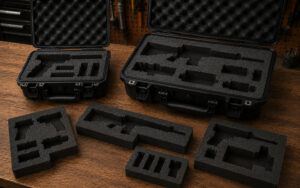
Choosing between pluck foam and solid foam depends on the type of equipment being protected, how often the layout may change, and the level of precision required.
Both foam types are widely used in protective hard cases for cameras, drones, electronics, tools, firearms, medical equipment, and specialist instruments. Each option offers different advantages for equipment organisation and protection.
The best choice depends on how the case will be used and the level of customisation needed.
What is pluck foam?
Pluck foam, sometimes called pick-and-pluck foam, is made from pre-scored foam cubes that can be removed by hand to create custom equipment compartments.
The foam is designed so sections can be removed without specialist cutting tools.
Pluck foam is commonly used because it allows quick and simple customisation for:
- Cameras and accessories
- Drones and controllers
- Tools and electronics
- Audio equipment
- General-purpose storage
What is solid foam?
Solid foam is a continuous sheet of foam without pre-cut sections.
Custom compartments are created by cutting the foam manually or using professional cutting equipment such as CNC machines.
Solid foam is commonly used for:
- Professional equipment cases
- Precision layouts
- High-value equipment
- Industrial equipment protection
- Presentation cases
It provides a cleaner and more precise finish than pluck foam.
What are the advantages of pluck foam?
Pluck foam is popular because it is quick and easy to customise.
Main advantages include:
- No specialist tools required
- Fast setup and modification
- Flexible layouts
- Suitable for changing equipment setups
- Lower cost than custom-cut foam
It is often a practical option for users who need a simple custom layout without investing in professional foam cutting.
What are the disadvantages of pluck foam?
Although pluck foam is convenient, it has some limitations.
Potential disadvantages include:
- Less precise fit around equipment
- Visible stepped edges from removed cubes
- Reduced long-term durability in some cases
- Less professional appearance
- Limited detail for complex shapes
The pre-scored sections can also weaken the foam slightly over time, particularly with heavier equipment.
What are the advantages of solid foam?
Solid foam provides greater precision and a cleaner overall finish.
Main advantages include:
- Highly accurate custom shapes
- Smoother compartment edges
- Better support for heavy equipment
- Professional presentation
- Improved long-term durability
Solid foam is often preferred for expensive or fragile equipment where maximum protection and organisation are important.
What are the disadvantages of solid foam?
Solid foam requires more time, tools, and skill to customise.
Potential disadvantages include:
- More difficult to modify
- Requires cutting tools or CNC services
- Takes longer to create layouts
- Higher cost for professional cutting
Once cut, the layout is also less flexible if equipment changes later.
Which foam type offers better protection?
Both foam types can provide excellent protection when designed properly, but solid foam generally offers more consistent support because it has a continuous structure without perforations.
Solid foam is often better for:
- Heavy equipment
- Delicate instruments
- Professional transport
- Frequent travel
- Industrial applications
Pluck foam still provides strong protection for many general-purpose applications, particularly when the equipment is lightweight or not highly sensitive.
Which foam type is easier to customise?
Pluck foam is much easier and faster to customise because the foam sections can be removed by hand.
This makes it useful for:
- DIY case setups
- Temporary layouts
- Changing equipment collections
- First-time users
Solid foam requires careful measuring and cutting, but it allows far more precision and flexibility in shape design.
What types of equipment work best with pluck foam?
Pluck foam works well for equipment that:
- Has relatively simple shapes
- Changes frequently
- Does not require highly detailed fitting
- Needs a quick and affordable solution
It is commonly used for:
- General electronics
- Basic camera kits
- Tool storage
- Drone accessories
What types of equipment work best with solid foam?
Solid foam is ideal for equipment requiring more precise support and long-term protection.
This includes:
- Professional camera systems
- Medical equipment
- Scientific instruments
- Industrial electronics
- Firearms and accessories
- Precision tools
It is also preferred for high-end presentation and display cases because of the cleaner appearance.
What foam materials are available in pluck and solid foam?
Both pluck foam and solid foam are available in different foam materials depending on the protection requirements.
- Polyethylene foam: Firm, durable, and impact resistant.
- Polyurethane foam: Softer and better for delicate surfaces.
- EVA foam: Dense and ideal for precision-cut layouts.
The foam material itself often affects protection levels more than whether the foam is pluck or solid.
Which option is best overall?
The best option depends on the balance between flexibility, precision, appearance, and budget.
Pluck foam is usually best for:
- Quick DIY setups
- Changing layouts
- General-purpose protection
- Lower-cost customisation
Solid foam is usually best for:
- Maximum protection
- Professional presentation
- Precise equipment fitting
- Long-term dedicated layouts
Both options can work extremely well inside a quality protective hard case when matched correctly to the equipment and intended use.