Yes, equipment should always have extra space around it inside protective hard cases.
This clearance is important because it allows protective padding and foam inserts to absorb impacts properly during transport and storage.
Without enough space, equipment can press directly against the case walls, increasing the risk of damage from shocks, vibration, pressure, and temperature changes.
Why is extra space important inside protective cases?
Protective hard cases are designed to work together with foam padding and shock-absorbing materials.
The foam needs room to compress during impacts so it can distribute force away from the equipment safely.
If equipment fits too tightly:
- Pressure points can develop
- Foam cannot absorb impacts effectively
- Vibration transfers directly into the equipment
- Case walls may contact delicate components
Proper spacing helps maintain consistent protection across the entire piece of equipment.
How much clearance should be left around equipment?
Most equipment requires approximately 12 mm to 25 mm of clearance around all sides.
More delicate or expensive equipment may require greater spacing.
Typical spacing recommendations
- Small electronics: 12 mm to 15 mm
- Cameras and lenses: 15 mm to 25 mm
- Drones and controllers: 20 mm to 25 mm
- Precision instruments: 25 mm or more
- Heavy industrial tools: 12 mm to 18 mm
The exact amount depends on:
- Equipment fragility
- Transport conditions
- Foam density
- Equipment weight
- Expected vibration or impacts
What happens if a case is too tight?
A case that is too tight can create several problems.
Potential risks include:
- Cracked screens or housings
- Pressure damage to controls or buttons
- Foam compression damage
- Restricted airflow
- Difficulty removing equipment safely
Excessive pressure may also damage sensitive components over time, particularly during temperature changes.
Can too much empty space also cause problems?
Yes. Too much unused space allows equipment to move around inside the case.
This movement increases the risk of:
- Impact damage
- Vibration wear
- Accessories colliding with equipment
- Uneven pressure during transport
The goal is to create a secure fit with controlled cushioning rather than a completely loose or extremely tight fit.
Why does foam compression matter?
Protective foam is designed to compress slightly during impacts.
This compression helps:
- Absorb shock energy
- Reduce vibration transfer
- Protect delicate surfaces
- Distribute impact forces evenly
Without enough room for compression, the foam cannot function correctly.
How do temperature changes affect equipment spacing?
Equipment and foam materials naturally expand and contract with temperature changes.
This is especially important for:
- Metal equipment
- Camera lenses
- Electronics
- Battery-powered devices
A case that fits tightly at room temperature may become overly compressed in hot conditions.
Leaving proper clearance helps prevent stress caused by thermal expansion.
What type of foam works best for equipment spacing?
Different foam materials provide different levels of support and compression.
Polyethylene foam
Polyethylene foam is commonly used for rugged protection and heavy equipment.
It offers:
- High durability
- Good shock absorption
- Moisture resistance
Polyurethane foam
Polyurethane foam is softer and better suited for delicate equipment.
It is commonly used for:
- Cameras
- Optics
- Electronics
EVA foam
EVA foam provides firm support with excellent dimensional stability.
It is often used for:
- Complex equipment layouts
- Professional presentations
- Custom foam interiors
Are custom foam inserts better than generic foam?
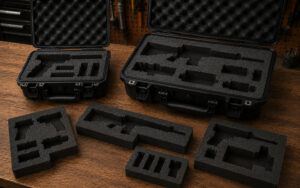
Custom foam inserts usually provide better protection because they are designed around the exact shape of the equipment.
Benefits include:
- More consistent spacing
- Reduced movement
- Improved shock absorption
- Better equipment organisation
CNC-cut foam inserts are especially useful for valuable or sensitive equipment that travels regularly.
How should accessories be positioned inside a case?
Accessories should have their own separate compartments whenever possible.
This helps prevent:
- Cables scratching equipment
- Batteries impacting delicate surfaces
- Loose parts moving during transport
Items such as chargers, batteries, memory cards, and tools should not be stored loosely beside the main equipment.
How do you choose the correct case size?
Start by measuring the equipment at its largest points.
You should include:
- Handles
- Attachments
- Protective covers
- Mounted accessories
Then add enough space for:
- Protective foam
- Shock absorption
- Accessory storage
- Safe equipment removal
Always compare these measurements against the internal dimensions of the protective case.
Why proper spacing improves long-term equipment protection
Correct spacing inside protective hard cases helps reduce impact damage, vibration wear, moisture issues, and pressure-related stress.
When combined with quality foam inserts and proper case sizing, adequate clearance helps keep equipment secure and protected during transport, storage, and professional use.