Measuring equipment correctly is one of the most important steps when choosing the right protective hard case.
Accurate measurements help ensure there is enough room for the equipment, protective foam, accessories, and safe clearance inside the case without leaving excessive empty space.
Proper sizing also improves impact protection, organisation, and ease of transport.
What measurements do you need for case sizing?
The three main measurements required are:
- Length
- Width
- Height
These measurements should always be taken at the widest points of the equipment.
You should also consider:
- Weight of the equipment
- Handles or protruding parts
- Attached accessories
- Cables and chargers
- Protective foam thickness
How do you measure equipment correctly?
Place the equipment on a flat surface and measure the maximum dimensions from edge to edge.
For most equipment:
- Length: Measure the longest side.
- Width: Measure the widest side from left to right.
- Height: Measure from the base to the highest point.
Always measure with any permanently attached components in place.
For example:
- Measure cameras with attached lenses if stored assembled
- Measure drones in the folded position if transported folded
- Measure tools with handles or guards attached
Why are interior case dimensions important?
Protective hard cases have both exterior and interior dimensions.
Interior dimensions show the actual usable storage space inside the case.
Exterior dimensions include:
- The outer shell
- Handles
- Latches
- Wheels
- Wall thickness
When sizing equipment, always compare your measurements against the case’s internal dimensions.
How much extra space should you allow inside the case?
Extra space is needed for foam padding and impact protection.
General recommendations include:
- 12 mm to 25 mm clearance for rugged equipment
- 25 mm to 50 mm clearance for fragile electronics
- Additional space for accessories and cables
This space helps absorb impacts and reduces equipment movement inside the case.
How do you measure irregularly shaped equipment?
Irregular equipment should be measured using the maximum outer dimensions.
A useful method is to imagine an invisible rectangular box around the equipment and measure the furthest points in every direction.
This is especially useful for:
- Drones
- Camera rigs
- Audio mixers
- Medical equipment
- Industrial tools
If the shape is particularly complex, creating a cardboard template can help visualise the required compartment size.
Should accessories be measured separately?
Yes. Accessories should always be included in the case layout planning.
This may include:
- Batteries
- Chargers
- Cables
- Memory cards
- Controllers
- Microphones
- Small tools
Each item should have its own protected space where possible to reduce movement and improve organisation.
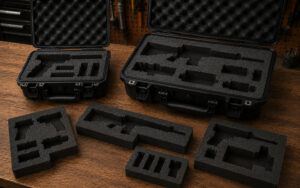
How does foam affect case sizing?
Protective foam reduces the available internal storage space because it surrounds the equipment inside the case.
Foam thickness depends on:
- Equipment fragility
- Equipment weight
- Transport conditions
- Required shock absorption
Cases designed with custom foam inserts usually require more internal space than simple divider systems.
What are the most common mistakes when measuring for a case?
Several common mistakes can lead to choosing the wrong case size.
Ignoring foam thickness
Many people measure only the equipment itself and forget to allow room for protective padding.
Forgetting protruding parts
Handles, lenses, knobs, antennas, and mounted accessories can easily be overlooked.
Not accounting for accessories
Chargers, batteries, and cables often require more space than expected.
Confusing internal and external dimensions
Using exterior measurements instead of interior dimensions can result in selecting a case that is too small.
How does equipment weight affect case selection?
Heavier equipment requires stronger support and more durable foam materials.
Weight also affects:
- Case portability
- Wheel and handle requirements
- Foam density selection
- Impact protection needs
Professional protective cases include weight capacity ratings to ensure safe transport and long-term durability.
How do you size a case for multiple pieces of equipment?
When storing multiple items in the same case, each item should have:
- Its own compartment
- Adequate foam spacing
- Protection from movement
- Easy access for removal
A minimum spacing of around 12 mm to 25 mm of foam between items is commonly recommended.
Heavy items should usually be positioned near the base of the case to improve balance and reduce stress on delicate equipment.
What tools are useful for accurate measurements?
Useful measuring tools include:
- Tape measures
- Metal rulers
- Digital callipers
- Cardboard templates
- Layout sketches
For custom foam inserts, precise measurements are especially important to achieve a secure and professional fit.
Why proper case sizing matters
Correct case sizing improves equipment protection, transport safety, and overall usability.
A properly sized protective hard case should:
- Hold equipment securely
- Allow room for protective foam
- Prevent unnecessary movement
- Protect against impact and vibration
- Remain practical for transport and storage
Careful measurement helps avoid costly mistakes and ensures sensitive or valuable equipment stays properly protected in real-world conditions.