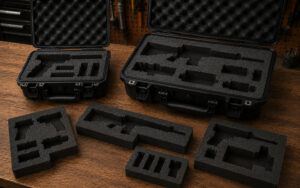
Yes, most drone cases benefit significantly from special foam inserts because drones contain delicate components that are vulnerable to vibration, impact, and movement during transport.
Foam inserts create secure compartments that:
- Prevent movement inside the case
- Absorb shock and vibration
- Protect cameras and gimbals
- Organise accessories safely
- Reduce pressure on fragile parts
Professional drone operators almost always use foam inserts inside hard protective cases to improve equipment safety and long-term reliability.
What are foam inserts in drone cases?
Foam inserts are protective padding systems designed to hold drone equipment securely inside hard cases.
The foam is cut or shaped to create separate compartments for:
- The drone body
- Controllers
- Batteries
- Propellers
- Chargers
- Cables
- Accessories
The main purpose is to stop equipment shifting during transport while cushioning against impacts and vibration.
Why do drones need foam protection?
Drones contain multiple sensitive components that can be damaged easily if they move around inside a case.
Gimbal protection
The gimbal is one of the most delicate parts of any drone.
Foam inserts help stabilise the aircraft and reduce movement that could damage:
- Motors
- Stabilisers
- Calibration systems
Camera protection
Drone cameras contain:
- Precision optics
- Sensors
- Delicate coatings
Foam reduces vibration and impact forces that could affect image quality or alignment.
Battery safety
Lithium batteries should remain stable during transport.
Foam compartments help:
- Prevent impact damage
- Reduce short-circuit risks
- Keep batteries organised
Accessory organisation
Foam inserts prevent smaller items like propellers and cables from colliding with sensitive electronics.
Do all drone cases come with foam inserts?
No. Some drone cases include foam inserts as standard, while others provide only empty shells or basic padding.
Budget drone cases
Lower-cost cases often include:
- Thin foam sheets
- Basic padding
- Minimal compartment systems
Protection levels may be limited.
Pick-and-pluck foam systems
Many mid-range hard cases include pick-and-pluck foam.
This foam contains pre-scored cubes that users remove manually to create custom compartments.
It offers flexibility but less precision than professionally cut inserts.
Custom-cut foam inserts
Premium drone cases may include precision-cut foam designed specifically for certain drone models.
These inserts provide:
- Exact fitment
- Maximum movement prevention
- Professional organisation
What’s the difference between custom foam and generic foam?
Custom-cut foam
Custom foam is designed specifically around your drone and accessories.
It provides:
- Precise equipment fit
- Clean professional appearance
- Better impact protection
- Improved organisation
Professional services often use:
- 3D scanning
- CNC cutting
- Laser cutting
to create exact layouts.
Generic foam padding
Generic foam provides more basic protection.
It may:
- Require manual cutting
- Leave small gaps
- Allow slight equipment movement
However, it is:
- Cheaper
- More flexible
- Easier to modify later
Which foam materials work best for drone protection?
Polyethylene foam
This is one of the best options for drone transport because it offers:
- High impact resistance
- Moisture resistance
- Strong structural support
It works particularly well in rugged outdoor environments.
Polyurethane foam
Polyurethane foam is softer and ideal for:
- Cameras
- Screens
- Sensitive surfaces
It helps prevent scratches and surface pressure damage.
EVA foam
EVA foam provides:
- Firm support
- Clean cutting edges
- Excellent dimensional stability
making it popular for precision-cut drone case layouts.
Can you make your own foam inserts?
Yes. Many drone users create DIY foam inserts using foam sheets or pick-and-pluck systems.
Basic DIY process
- Measure all equipment carefully
- Create a layout plan
- Mark foam cut lines
- Cut slowly with sharp tools
- Test fit each component
Tools commonly used
- Craft knives
- Electric carving knives
- Hot wire cutters
- Metal rulers
DIY foam works well for many recreational users, although achieving professional-level precision takes time and patience.
When should you invest in professional foam inserts?
Professional foam inserts are usually worth it when:
- Your drone equipment is expensive
- You travel frequently
- You work commercially
- You fly in harsh environments
- You need maximum protection
Commercial drone operators often transport:
- Multiple batteries
- Controllers
- Filters
- Monitors
- RTK equipment
Professional foam layouts improve both protection and workflow efficiency.
Are foam inserts necessary for all drones?
Not always.
Small recreational drones used occasionally may be adequately protected using:
- Basic padded bags
- Simple foam compartments
However, hard cases with proper foam inserts become increasingly important as:
- Equipment value increases
- Travel frequency increases
- Environmental conditions become harsher
- Accessory count grows
What should you look for in a drone case foam layout?
Snug equipment fit
Components should not move during transport but also should not be compressed tightly.
Battery separation
Batteries should have dedicated compartments separated from sensitive electronics.
Accessory organisation
Small items should remain isolated to prevent scratches or impact damage.
Easy access
Foam layouts should allow quick removal and replacement of equipment during field work.
Future expansion
Some users leave space for:
- Extra batteries
- Additional filters
- Upgraded controllers
Why professional drone operators prefer custom foam systems
Professional drone work often involves:
- Frequent transport
- Outdoor environments
- Air travel
- High-value equipment
Custom foam systems inside hard protective cases provide:
- Better impact protection
- Faster setup and packing
- Improved organisation
- Reduced equipment wear
- More professional presentation
For many drone operators, quality foam inserts are considered an essential part of long-term equipment protection rather than an optional extra.